 English
 Pусский
 日本語
 العربية

 Catalogar




Elastic Recovery
Elastic RecoveryElastic recovery is a fundamental property of materials that describes their ability to return to their original shape and size after being subjected to external forces or deformations. This phenomenon is primarily observed in elastic materials, such as metals, polymers, and certain biological tissues, which can undergo temporary deformation when a force is applied and then recover their initial configuration once the force is removed. Elastic recovery is a critical concept in materials science, engineering, and manufacturing, as it influences the performance, durability, and functionality of materials in various applications.At the microscopic level, elastic recovery is governed by the material's atomic or molecular structure. In elastic deformation, the bonds between atoms or molecules are stretched or compressed, but they do not break or permanently rearrange. When the external force is removed, these bonds return to their equilibrium positions, allowing the material to regain its original shape. This behavior is described by Hooke's Law, which states that the stress (force per unit area) applied to a material is directly proportional to the strain (deformation) it experiences, within the material's elastic limit. The proportionality constant is known as the elastic modulus or Young's modulus, which quantifies the material's stiffness.Elastic recovery is particularly important in applications where materials are subjected to repeated loading and unloading cycles, such as springs, tires, and structural components. For example, in automotive engineering, the elastic recovery of rubber tires ensures that they maintain their shape and grip on the road, even after encountering bumps or potholes. Similarly, in aerospace engineering, the elastic recovery of metal alloys used in aircraft wings allows them to withstand aerodynamic forces without permanent deformation.However, the extent of elastic recovery depends on several factors, including the material's composition, temperature, and the magnitude and duration of the applied force. If the force exceeds the material's elastic limit, it may undergo plastic deformation, where the bonds are permanently rearranged, and the material cannot fully recover its original shape. This transition from elastic to plastic behavior is a key consideration in material selection and design.In summary, elastic recovery is a vital property that enables materials to withstand deformation and return to their original state, ensuring their reliability and longevity in various applications. Understanding and optimizing this property is essential for developing materials that can perform effectively under mechanical stress while maintaining their structural integrity.
Producto
Categoría:
-
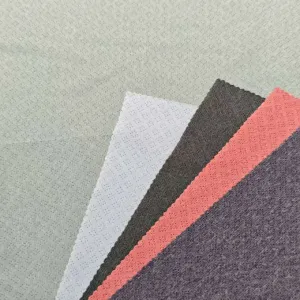
RXSP-4.01.0702 Serie Pro Fit sin costuras (14)
Su clasificación: TelasVistas: 418Número:Tiempo de liberación: 2025-08-05 10:10:18RXSP-4.01.0702: Tejido sin costuras 55,9 % nailon/17,9 % poliéster/26,2 % fibra especial. El peso de 165 g/m² optimiza la movilidad y el soporte para prendas deportivas de élite en soluciones multicolores.
Noticias
Categoría:
¡Sin resultados de búsqueda!
Caso
Categoría:
¡Sin resultados de búsqueda!
Video
Categoría:
¡Sin resultados de búsqueda!
Descargar
Categoría:
¡Sin resultados de búsqueda!
Reclutamiento
Categoría:
¡Sin resultados de búsqueda!
Productos recomendados
¡Sin resultados de búsqueda!



 Teléfono